PlatformEngineering.org My Courses FAQs

Agentic Platforms Bundle

rate limit

Code not recognized.

NEW LEARNING PATH

Master AI-powered platform engineering from strategy to autonomous agents

Two courses. One complete path. Go from platform design to safe, governed agent execution.

 
View individual courses

86% report platform engineering is essential to realizing AI's business value

Your AI platform engineering learning path

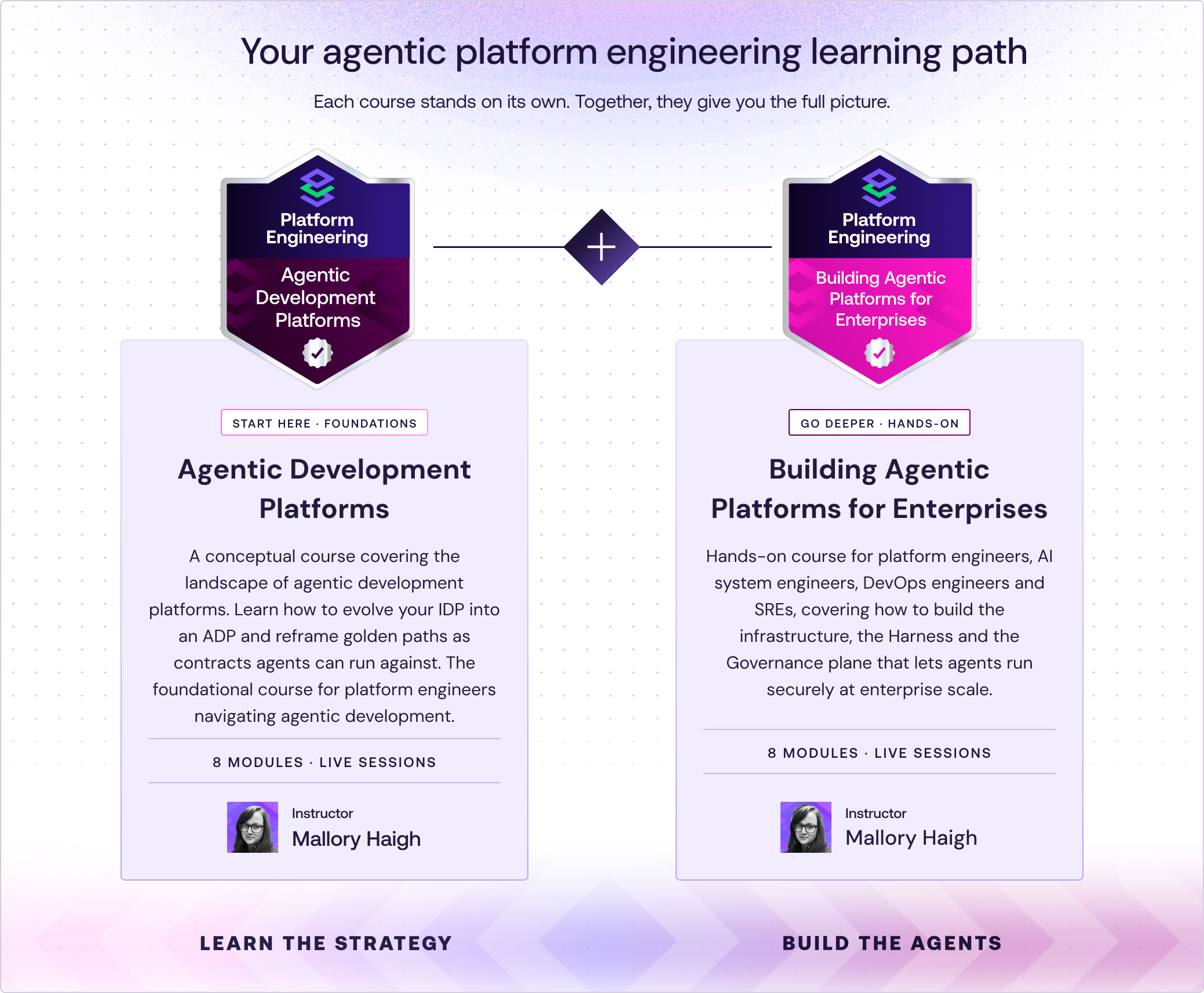
Your agentic platform engineering learning path

Each course stands on its own. Together, they give you the full picture.

Agentic Development Platforms badge
START HERE · FOUNDATIONS

Agentic Development Platforms

A conceptual course covering the landscape of agentic development platforms. Learn how to evolve your IDP into an ADP and reframe golden paths as contracts agents can run against. The foundational course for platform engineers navigating agentic development.

8 MODULES · LIVE SESSIONS
Mallory Haigh
Instructor Mallory Haigh
Learn more
Building Agentic Platforms for Enterprises badge
GO DEEPER · HANDS-ON

Building Agentic Platforms for Enterprises

Hands-on course for platform engineers, AI system engineers, DevOps engineers and SREs, covering how to build the infrastructure, the Harness and the Governance plane that lets agents run securely at enterprise scale.

8 MODULES · LIVE SESSIONS
Mallory Haigh
Instructor Mallory Haigh
Learn more
Get both courses as a bundle - Save 20% - $1,500 Get both courses as a bundle - Save 20% - $1,500

Why take both?

The first one defines the paths agents follow. The second builds what those paths run on.

Agentic Development Platforms badge Building Agentic Platforms for Enterprises badge
  • Start with the architecture

    The Agentic Development Platforms’ three-layer architecture and golden paths reframed as contracts agents can dispatch against.

  • Then build the substrate

    Identity, context, capability, execution, evaluation, security, and observability, wired into one governed path.

  • One complete, governed skill set

    Platform architecture to production-grade agent execution, end to end.

What you'll learn

17 modules across two courses. Strategy first, then hands-on, or take them independently at your own pace.

Agentic Development Platforms

CURRICULUM
Mallory Haigh
Instructor Mallory Haigh
9 MODULES · 9 QUIZZES · LIVE COHORT SESSIONS
MODULE 1 The harness reframe
SDLC → Agentic SDLC: the ADP as the enterprise harness
Why this is not a model-selection problem
The two curves: deterministic spine, probabilistic workers - ADP = IDP × agentic paths × agents = output²
The four levels of ADP autonomy as the course map
MODULE 2 Platform foundations, re-read for agents
State of AI and the platform engineering role today
The load-bearing vocabulary: IDP, golden paths, golden cages, self-service, platform-as-a-product
Each concept reframed through the agentic lens
Self-service for humans becomes safe delegation for humans and agents
MODULE 3 Anatomy of an ADP
The three layers in depth: tooling planes, command-paths, agent infrastructure
The 10 command-paths of an ADP
Where each layer is built and governed
The ADP reference architecture as a working design target
MODULE 4 From golden paths to machine-executable contracts
Golden paths as contracts agents can dispatch against
The three path types: probabilistic, deterministic, hybrid
The paths × ASDLC-stages matrix as the operating map
Live self-assessment: where is your organization on the maturity model?
MODULE 5 Level 1 today - agents in the loop
What Level 1 looks like: assistive and task control modes
Your existing paths (ci-build, sec-scan, deploy) are already the harness
The ADP Hamburger Model: existing platform work as foundation, not liability
The SDLC/skill-matrix as the working framework
MODULE 6 The jump, part 1 - when validation becomes a loop
Why Level 1 → Level 2 is the hardest and highest-payoff transition
The hybrid path pattern: probabilistic step → deterministic gate → retry until pass
TEST as the convergence stage in the Agentic SDLC
Hands-on lab: building /validate-change and /implement-change
MODULE 7 The jump, part 2 - agent infrastructure for level 2
The components for running agents safely on the loop: context assembly, tool gateway, execution substrate, trust plane, evaluation, observability
The four control modes: assistive, task, workflow, bounded autonomy
The human shift from in-the-loop approver to on-the-loop orchestrator
Hands-on lab
MODULE 8 Preview - level 3 and the horizon
Level 2 → Level 3: background execution, rule-based promotion
How the paths × ASDLC matrix expands with autonomy
Level 4 as an honest horizon: emerging vs. proven
What must be in place before Level 3 is viable
MODULE 9 Your roadmap - what to do now
Building the org-specific transition plan from your self-assessment
Assess → prioritize → build: L1 → L2 → L3
Platform design over model selection, restated
Bringing leadership along: the business case for platform investment

Live sessions

COHORT-BASED SESSIONS WITH THE INSTRUCTOR
KICKOFF OCT 1 · 16:30 CET
LIVE Q&A #1 OCT 8 · 16:30 CET
MODULE 5 (LIVE) OCT 15 · 16:30 CET
LIVE Q&A #2 OCT 22 · 16:30 CET
FINAL Q&A OCT 29 · 16:30 CET

Building Agentic Platforms for Enterprises

CURRICULUM
Mallory Haigh
Instructor Mallory Haigh
8 MODULES · 8 QUIZZES · 3 LABS · LIVE COHORT SESSIONS
MODULE 1 The substrate that runs paths in your enterprise
Where this course sits in the ADP curriculum: IDP → paths → agent infrastructure
The three eras: prompt engineering → context engineering → harness engineering
Why platform quality, not model quality, determines agent reliability
The seven-pillar map as the course spine; Agent Infrastructure as Code
One substrate for sales, marketing, finance, HR
MODULE 2 Identity & security: the permission surface
Non-human identity: agents as first-class principals with least-privilege credentials
The 3-tier permission middleware: Safe, Moderate, Dangerous
Policy-as-code guardrails (OPA), prompt-injection defence, PII scrubbing, audit logging
Lab: wire a 3-tier permission gate into a governed path
MODULE 3 Context: what the agent knows
Context sources: repos, tickets, runbooks, incident history, telemetry
Just-in-time assembly and graph-based relevance vs. "dump everything into RAG"
Memory and state across a task
Access control and trusted data lineage: agents read only governed sources
MODULE 4 Capability: what the agent can touch
Tools as governed capability grants: every tool an explicit, scoped entitlement
MCP, A2A, and AGNTCY interop; gateways as the capability plane
Entitlement mapping back to the permission tiers
Non-technical scoping: the finance agent gets the reconciliation API, not the platform
MODULE 5 Execution: where agents run
The Bounded ReAct Loop: iteration ceilings, compaction, approval gates
Control modes from assistive to bounded autonomy
Orchestration, model gateway, sandboxed runtimes (LangGraph, LiteLLM, Kubernetes, Temporal, E2B)
Lab: run an unbounded loop, observe failure modes, then add ceilings and sandbox
MODULE 6 Evaluation & observability: the feedback surface
Evaluative gates: LLM-as-Judge, output rubrics, promotion rules
Traces, cost signals, silent failure, and drift detection
FinOps as first-class: per-action cost, token routing, chargeback/showback
Closing the loop: drift detection triggering automated remediation
MODULE 7 The full-path build: wiring seven pillars into one path
Walking a /pr-review path end to end through all seven pillars
What breaks when a pillar is missing
Capstone lab: assemble Modules 2–6 into one running governed path
MODULE 8 Beyond software: enterprise agentic platforms and the business case
The same seven pillars running marketing, sales, and finance platforms
Worked example: an autonomous marketing workflow on shared infrastructure
Proving platform value: evaluation methodology for the leadership business case
Roadmap: assess pillar maturity, prioritize, define the journey

Live sessions

COHORT-BASED SESSIONS WITH THE INSTRUCTOR
KICKOFF NOV 12 · 16:30 CET
LIVE Q&A #1 NOV 19 · 16:30 CET
MODULE 5 (LIVE) NOV 26 · 16:30 CET
LIVE Q&A #2 DEC 3 · 16:30 CET
MODULE 7 (LIVE) DEC 10 · 16:30 CET
FINAL Q&A DEC 17 · 16:30 CET
AI BUNDLE

The complete AI platform engineering path

$1,900 $1,500 SAVE 20%

For those who want the complete, end-to-end path from building AI-ready platform foundations to deploying autonomous agents.

Explore each course individually

What you get

  • Apply the ADP three-layer architecture to your own platform
  • Reframe golden paths as contracts agents can dispatch against
  • Build the seven-pillar agent infrastructure layer, including identity, context, capability, execution, and evaluation
  • Implement a 3-tier permission gate that checks every agent action before it executes
  • Instrument evaluation and observability pipelines that close the governance loop


Meet the instructor

Mallory Haigh

Mallory Haigh

Course Instructor and Platform Engineering SME

Teaches Agentic Development Platforms and Building Agentic Platforms for Enterprises

LinkedIn icon Connect with me on LinkedIn
  • bullet-icon Full-stack engineer by background (LAMP stack veteran + PHP lifer)
  • bullet-icon Engineering management, customer success, product development
  • bullet-icon Shares knowledge and resources at olivercodes.com
  • bullet-icon Platform Engineering SME, course instructor, trainer, and coach
 
 
What our alumni say
 
Testimonials          
Name Image Position Text Linkedin LinkedinPost
Jay Moran SVP of Platform Engineering & Distinguished Engineer at Fiserv I don’t often feel certifications are too useful, but in this case beyond being not vendor specific, I think this is one certification that really helps define a “Platform Engineer” versus someone who does some of the many components of what goes into platform engineering… https://www.linkedin.com/in/jaycmoran/ https://www.linkedin.com/posts/jaycmoran_platformasaproduct-idp-platformengineering-activity-7364777833262448641-ku7Z/?utm_source=share&utm_medium=member_desktop&rcm=ACoAAB7W6ucBwi1gPqF5QCBe36ipfkH_n4Cityo
Daniel Palermi Senior Cloud Engineer at Serko The Platform Engineering Practitioner certification helped me understand the evolution of DevOps and engineering practices over the years. It clarified the concept of platform engineering and its true purpose. In my opinion, everyone working in an IT company should take this course, as it offers valuable lessons that span across all roles.

https://www.linkedin.com/in/daniel-palermi-4a5b881b/  
Brittany Lebel Senior Product Owner, Kinsale Insurance The Platform Engineering course was a transformative addition to my career. The content was well-structured, covering everything from designing Platform Engineering Maturity  Models to developing reference architectures that drive standardization and empower developers with seamless self-service capabilities. The hands-on lectures on Pocket IDP provided an in-depth exploration of the entire implementation process, diving into technical details and real-case scenarios. This comprehensive approach offered invaluable insights into how an IDP functions as a product and how it can efficiently support production workloads.Thanks to this course, I now have the expertise to contribute meaningfully to the development and enhancement of our Internal Developer Platform, enabling us to accelerate application delivery cycles.I highly recommend this course to anyone eager to elevate their engineering expertise and make a tangible impact in platform engineering! https://www.linkedin.com/in/brittany-lebel/  
Marc Schnitzius Service Lead Platform Engineering at Codecentric AG The Platform Engineering  Certified Practitioner course is a great guide for better understanding that the success of an internal developer platform is not just about making developers happy and shifting all their problems to a platform team. https://www.linkedin.com/in/marc-schnitzius/  
Rafael de Araujo Pires Global Director of Architecture at AB InBev The Platform Engineering Practitioner certification was more than concepts. It was a reflection on my own platform journey since 2022.The biggest lesson? Platforms are about people. It’s about listening, building trust, and reducing friction so teams can deliver value with autonomy. It’s about connecting culture, product, and technology, and showing that developer satisfaction can be as strategic as any infrastructure investment.Platform engineering isn’t just code: it’s people, trust, and real business impact. https://www.linkedin.com/in/rafaeldearaujop/  


Ready to lead the AI-native era of platform engineering?

Start with the foundations. Build the agents. Transform your platform.

Option
Price
Option
Agentic Development Platforms badge Agentic Development Platforms
$950
Building Agentic Platforms for Enterprises badge Building Agentic Platforms for Enterprises
$950
Agentic Development Platforms badge Building Agentic Platforms for Enterprises badge
Agentic Platforms Bundle BEST VALUE
$1,900 $1,500


Question Answer

What is Platform Engineering University?

Platform Engineering University is the leading education and certification provider focused on the discipline of platform engineering - from foundational concepts to building enterprise-grade Internal Developer Platforms (IDPs) and scaling them.

Who are the courses designed for?

The courses cater to a range of profiles, including:

  • Anyone wanting to upskill in platform engineering
  • Engineering managers, directors or platform leads wanting to understand strategy, adoption, ROI.
  • Teams or organizations that want to train multiple members (group bundles)

How are the courses structured?

We offer two distinct categories of courses designed to cater to different learning preferences and professional development needs:

Certification courses:

These are premium, paid offerings that provide a comprehensive, instructor-led learning experience. Our certification courses blend the best of both worlds, incorporating interactive live sessions with our expert instructors and flexible on-demand content. This hybrid approach allows for real-time engagement and Q&A, while also providing the convenience of self-paced study to accommodate diverse schedules. Upon passing the exam, participants receive a valuable certification, validating their acquired skills and knowledge in a specific domain.

Free specialty courses:

For those looking to explore specific topics or enhance their skills without a financial commitment, our free specialty courses are an excellent option. These courses are delivered entirely on-demand, offering complete flexibility for learners to progress at their own pace, anytime and anywhere. While these courses do not lead to a formal certification, they are meticulously designed to provide in-depth knowledge and practical insights into specialized areas, empowering individuals to expand their expertise and stay current with industry trends.

Which certification course should I take?

Platform Engineering Certified Practitioner

Best for everyone (engineers, architects, and technical leaders) who want to master the foundations.

Learn how to design an Internal Developer Platform, build golden paths, and drive adoption.

Ideal for:

  • DevOps & SREs moving into platform roles
  • Platform engineers designing or improving IDPs
  • Engineering managers aligning teams around platform-as-a-product

Start here if you're building or operating platforms and want practical frameworks.

Platform Engineering Certified Professional

For graduates of Practitioner ready to go deeper.

Focus on business impact, ROI, scaling to production, and advanced topics like security.

Ideal for:

  • Senior platform engineers and leads
  • Teams scaling existing platform initiatives

Choose this if you already understand the fundamentals and want to lead org-wide adoption.

Platform Engineering Certified Leader (or Leadership Bundle)

For Directors, VPs, and any kind of leaders shaping platform strategy.

Learn to align platform engineering with business goals, champion cultural transformation, governance and prove ROI.

Ideal for:

  • Platform product managers and heads of platform
  • Mid- and senior-level managers
  • Executives responsible for long-term platform investment

Take the Leadership Bundle (Practitioner + Leader) if you're defining, funding, or governing platform strategy at scale.

Platform Engineering Certified Architect

For graduates of Practitioner ready to go more technical.

Master the architectural foundations of any scalable, reliable and secure Kubernetes-based platform. 

Ideal for:

  • Platform engineers
  • Architects with focus on compliance and security

Choose this  for hands-on learning experience to implement compliance and security by design through best practices such as Policy as Code.

What prerequisite knowledge or tools do I need?

Prerequisites you will always find on the course detail page before you sign up. 


Some paid certificate courses require basic understanding of concepts and technologies like Infrastructure as Code, Terraform, Kubernetes etc. 

Are all courses live?

No. Many of our courses are self-paced and fully on-demand, allowing you to start anytime and learn at your own pace. Others are offered in live cohorts with scheduled sessions. Some combine both formats. Recordings are provided for all live sessions, so you'll never miss important content.

How does certification work?

Certification courses include final exams. Successfully completing these earns you an official certificate from Platform Engineering University valid for 12 months.

Will I receive a certificate or badge?

Yes. For free courses you will receive a digital completion badge, for paid certification courses you will get a digital certificate and badge after passing the exam.

What do I need to take part in a course?

All you need is a computer with internet access and a modern web browser. There's no need for specialized hardware or paid tools. Should a course require specific tooling, we will provide it through a Cloud Development Environment (CDE). This guarantees a consistent experience for all students, eliminating "works on my machine" issues.

What payment methods are accepted?

We accept major credit cards and other common online payment methods. Organizations can also request invoices and pay by bank transfer.

Can organizations enroll multiple people?

Yes. We offer team bundles and enterprise training options. Contact us at certifications@platformengineering.org for group pricing and custom solutions.

What is the refund or cancellation policy?

We currently don't offer refunds after enrollment, but you can transfer your seat to a future cohort if needed.

Is there a community for learners?

Yes. Many of our courses include access to a dedicated Slack workspace where you can ask questions, network with peers, and interact with instructors and alumni.

What happens after I complete a course?

Graduates gain access to alumni channels, community resources, and exclusive updates. Many learners continue with advanced certifications or specialized modules.

Are the courses vendor-neutral?

Yes. Our curriculum focuses on platform engineering principles, frameworks, and best practices - not on any single vendor's product. While we do talk about specific products occasionally, it comes always with the balance of comparables mentioned. While we do mention specific products from time to time, we always ensure a balanced comparison with similar alternatives.

Contents

About

NEW LEARNING PATH

Master AI-powered platform engineering from strategy to autonomous agents

Two courses. One complete path. Go from platform design to safe, governed agent execution.

 
View individual courses

86% report platform engineering is essential to realizing AI's business value

Your AI platform engineering learning path

Your agentic platform engineering learning path

Each course stands on its own. Together, they give you the full picture.

Agentic Development Platforms badge
START HERE · FOUNDATIONS

Agentic Development Platforms

A conceptual course covering the landscape of agentic development platforms. Learn how to evolve your IDP into an ADP and reframe golden paths as contracts agents can run against. The foundational course for platform engineers navigating agentic development.

8 MODULES · LIVE SESSIONS
Mallory Haigh
Instructor Mallory Haigh
Learn more
Building Agentic Platforms for Enterprises badge
GO DEEPER · HANDS-ON

Building Agentic Platforms for Enterprises

Hands-on course for platform engineers, AI system engineers, DevOps engineers and SREs, covering how to build the infrastructure, the Harness and the Governance plane that lets agents run securely at enterprise scale.

8 MODULES · LIVE SESSIONS
Mallory Haigh
Instructor Mallory Haigh
Learn more
Get both courses as a bundle - Save 20% - $1,500 Get both courses as a bundle - Save 20% - $1,500

Why take both?

The first one defines the paths agents follow. The second builds what those paths run on.

Agentic Development Platforms badge Building Agentic Platforms for Enterprises badge
  • Start with the architecture

    The Agentic Development Platforms’ three-layer architecture and golden paths reframed as contracts agents can dispatch against.

  • Then build the substrate

    Identity, context, capability, execution, evaluation, security, and observability, wired into one governed path.

  • One complete, governed skill set

    Platform architecture to production-grade agent execution, end to end.

What you'll learn

17 modules across two courses. Strategy first, then hands-on, or take them independently at your own pace.

Agentic Development Platforms

CURRICULUM
Mallory Haigh
Instructor Mallory Haigh
9 MODULES · 9 QUIZZES · LIVE COHORT SESSIONS
MODULE 1 The harness reframe
SDLC → Agentic SDLC: the ADP as the enterprise harness
Why this is not a model-selection problem
The two curves: deterministic spine, probabilistic workers - ADP = IDP × agentic paths × agents = output²
The four levels of ADP autonomy as the course map
MODULE 2 Platform foundations, re-read for agents
State of AI and the platform engineering role today
The load-bearing vocabulary: IDP, golden paths, golden cages, self-service, platform-as-a-product
Each concept reframed through the agentic lens
Self-service for humans becomes safe delegation for humans and agents
MODULE 3 Anatomy of an ADP
The three layers in depth: tooling planes, command-paths, agent infrastructure
The 10 command-paths of an ADP
Where each layer is built and governed
The ADP reference architecture as a working design target
MODULE 4 From golden paths to machine-executable contracts
Golden paths as contracts agents can dispatch against
The three path types: probabilistic, deterministic, hybrid
The paths × ASDLC-stages matrix as the operating map
Live self-assessment: where is your organization on the maturity model?
MODULE 5 Level 1 today - agents in the loop
What Level 1 looks like: assistive and task control modes
Your existing paths (ci-build, sec-scan, deploy) are already the harness
The ADP Hamburger Model: existing platform work as foundation, not liability
The SDLC/skill-matrix as the working framework
MODULE 6 The jump, part 1 - when validation becomes a loop
Why Level 1 → Level 2 is the hardest and highest-payoff transition
The hybrid path pattern: probabilistic step → deterministic gate → retry until pass
TEST as the convergence stage in the Agentic SDLC
Hands-on lab: building /validate-change and /implement-change
MODULE 7 The jump, part 2 - agent infrastructure for level 2
The components for running agents safely on the loop: context assembly, tool gateway, execution substrate, trust plane, evaluation, observability
The four control modes: assistive, task, workflow, bounded autonomy
The human shift from in-the-loop approver to on-the-loop orchestrator
Hands-on lab
MODULE 8 Preview - level 3 and the horizon
Level 2 → Level 3: background execution, rule-based promotion
How the paths × ASDLC matrix expands with autonomy
Level 4 as an honest horizon: emerging vs. proven
What must be in place before Level 3 is viable
MODULE 9 Your roadmap - what to do now
Building the org-specific transition plan from your self-assessment
Assess → prioritize → build: L1 → L2 → L3
Platform design over model selection, restated
Bringing leadership along: the business case for platform investment

Live sessions

COHORT-BASED SESSIONS WITH THE INSTRUCTOR
KICKOFF OCT 1 · 16:30 CET
LIVE Q&A #1 OCT 8 · 16:30 CET
MODULE 5 (LIVE) OCT 15 · 16:30 CET
LIVE Q&A #2 OCT 22 · 16:30 CET
FINAL Q&A OCT 29 · 16:30 CET

Building Agentic Platforms for Enterprises

CURRICULUM
Mallory Haigh
Instructor Mallory Haigh
8 MODULES · 8 QUIZZES · 3 LABS · LIVE COHORT SESSIONS
MODULE 1 The substrate that runs paths in your enterprise
Where this course sits in the ADP curriculum: IDP → paths → agent infrastructure
The three eras: prompt engineering → context engineering → harness engineering
Why platform quality, not model quality, determines agent reliability
The seven-pillar map as the course spine; Agent Infrastructure as Code
One substrate for sales, marketing, finance, HR
MODULE 2 Identity & security: the permission surface
Non-human identity: agents as first-class principals with least-privilege credentials
The 3-tier permission middleware: Safe, Moderate, Dangerous
Policy-as-code guardrails (OPA), prompt-injection defence, PII scrubbing, audit logging
Lab: wire a 3-tier permission gate into a governed path
MODULE 3 Context: what the agent knows
Context sources: repos, tickets, runbooks, incident history, telemetry
Just-in-time assembly and graph-based relevance vs. "dump everything into RAG"
Memory and state across a task
Access control and trusted data lineage: agents read only governed sources
MODULE 4 Capability: what the agent can touch
Tools as governed capability grants: every tool an explicit, scoped entitlement
MCP, A2A, and AGNTCY interop; gateways as the capability plane
Entitlement mapping back to the permission tiers
Non-technical scoping: the finance agent gets the reconciliation API, not the platform
MODULE 5 Execution: where agents run
The Bounded ReAct Loop: iteration ceilings, compaction, approval gates
Control modes from assistive to bounded autonomy
Orchestration, model gateway, sandboxed runtimes (LangGraph, LiteLLM, Kubernetes, Temporal, E2B)
Lab: run an unbounded loop, observe failure modes, then add ceilings and sandbox
MODULE 6 Evaluation & observability: the feedback surface
Evaluative gates: LLM-as-Judge, output rubrics, promotion rules
Traces, cost signals, silent failure, and drift detection
FinOps as first-class: per-action cost, token routing, chargeback/showback
Closing the loop: drift detection triggering automated remediation
MODULE 7 The full-path build: wiring seven pillars into one path
Walking a /pr-review path end to end through all seven pillars
What breaks when a pillar is missing
Capstone lab: assemble Modules 2–6 into one running governed path
MODULE 8 Beyond software: enterprise agentic platforms and the business case
The same seven pillars running marketing, sales, and finance platforms
Worked example: an autonomous marketing workflow on shared infrastructure
Proving platform value: evaluation methodology for the leadership business case
Roadmap: assess pillar maturity, prioritize, define the journey

Live sessions

COHORT-BASED SESSIONS WITH THE INSTRUCTOR
KICKOFF NOV 12 · 16:30 CET
LIVE Q&A #1 NOV 19 · 16:30 CET
MODULE 5 (LIVE) NOV 26 · 16:30 CET
LIVE Q&A #2 DEC 3 · 16:30 CET
MODULE 7 (LIVE) DEC 10 · 16:30 CET
FINAL Q&A DEC 17 · 16:30 CET
AI BUNDLE

The complete AI platform engineering path

$1,900 $1,500 SAVE 20%

For those who want the complete, end-to-end path from building AI-ready platform foundations to deploying autonomous agents.

Explore each course individually

What you get

  • Apply the ADP three-layer architecture to your own platform
  • Reframe golden paths as contracts agents can dispatch against
  • Build the seven-pillar agent infrastructure layer, including identity, context, capability, execution, and evaluation
  • Implement a 3-tier permission gate that checks every agent action before it executes
  • Instrument evaluation and observability pipelines that close the governance loop


Meet the instructor

Mallory Haigh

Mallory Haigh

Course Instructor and Platform Engineering SME

Teaches Agentic Development Platforms and Building Agentic Platforms for Enterprises

LinkedIn icon Connect with me on LinkedIn
  • bullet-icon Full-stack engineer by background (LAMP stack veteran + PHP lifer)
  • bullet-icon Engineering management, customer success, product development
  • bullet-icon Shares knowledge and resources at olivercodes.com
  • bullet-icon Platform Engineering SME, course instructor, trainer, and coach
 
 
What our alumni say
 
Testimonials          
Name Image Position Text Linkedin LinkedinPost
Jay Moran SVP of Platform Engineering & Distinguished Engineer at Fiserv I don’t often feel certifications are too useful, but in this case beyond being not vendor specific, I think this is one certification that really helps define a “Platform Engineer” versus someone who does some of the many components of what goes into platform engineering… https://www.linkedin.com/in/jaycmoran/ https://www.linkedin.com/posts/jaycmoran_platformasaproduct-idp-platformengineering-activity-7364777833262448641-ku7Z/?utm_source=share&utm_medium=member_desktop&rcm=ACoAAB7W6ucBwi1gPqF5QCBe36ipfkH_n4Cityo
Daniel Palermi Senior Cloud Engineer at Serko The Platform Engineering Practitioner certification helped me understand the evolution of DevOps and engineering practices over the years. It clarified the concept of platform engineering and its true purpose. In my opinion, everyone working in an IT company should take this course, as it offers valuable lessons that span across all roles.

https://www.linkedin.com/in/daniel-palermi-4a5b881b/  
Brittany Lebel Senior Product Owner, Kinsale Insurance The Platform Engineering course was a transformative addition to my career. The content was well-structured, covering everything from designing Platform Engineering Maturity  Models to developing reference architectures that drive standardization and empower developers with seamless self-service capabilities. The hands-on lectures on Pocket IDP provided an in-depth exploration of the entire implementation process, diving into technical details and real-case scenarios. This comprehensive approach offered invaluable insights into how an IDP functions as a product and how it can efficiently support production workloads.Thanks to this course, I now have the expertise to contribute meaningfully to the development and enhancement of our Internal Developer Platform, enabling us to accelerate application delivery cycles.I highly recommend this course to anyone eager to elevate their engineering expertise and make a tangible impact in platform engineering! https://www.linkedin.com/in/brittany-lebel/  
Marc Schnitzius Service Lead Platform Engineering at Codecentric AG The Platform Engineering  Certified Practitioner course is a great guide for better understanding that the success of an internal developer platform is not just about making developers happy and shifting all their problems to a platform team. https://www.linkedin.com/in/marc-schnitzius/  
Rafael de Araujo Pires Global Director of Architecture at AB InBev The Platform Engineering Practitioner certification was more than concepts. It was a reflection on my own platform journey since 2022.The biggest lesson? Platforms are about people. It’s about listening, building trust, and reducing friction so teams can deliver value with autonomy. It’s about connecting culture, product, and technology, and showing that developer satisfaction can be as strategic as any infrastructure investment.Platform engineering isn’t just code: it’s people, trust, and real business impact. https://www.linkedin.com/in/rafaeldearaujop/  


Ready to lead the AI-native era of platform engineering?

Start with the foundations. Build the agents. Transform your platform.

Option
Price
Option
Agentic Development Platforms badge Agentic Development Platforms
$950
Building Agentic Platforms for Enterprises badge Building Agentic Platforms for Enterprises
$950
Agentic Development Platforms badge Building Agentic Platforms for Enterprises badge
Agentic Platforms Bundle BEST VALUE

$1,900 $1,500


Question Answer

What is Platform Engineering University?

Platform Engineering University is the leading education and certification provider focused on the discipline of platform engineering - from foundational concepts to building enterprise-grade Internal Developer Platforms (IDPs) and scaling them.

Who are the courses designed for?

The courses cater to a range of profiles, including:

  • Anyone wanting to upskill in platform engineering
  • Engineering managers, directors or platform leads wanting to understand strategy, adoption, ROI.
  • Teams or organizations that want to train multiple members (group bundles)

How are the courses structured?

We offer two distinct categories of courses designed to cater to different learning preferences and professional development needs:

Certification courses:

These are premium, paid offerings that provide a comprehensive, instructor-led learning experience. Our certification courses blend the best of both worlds, incorporating interactive live sessions with our expert instructors and flexible on-demand content. This hybrid approach allows for real-time engagement and Q&A, while also providing the convenience of self-paced study to accommodate diverse schedules. Upon passing the exam, participants receive a valuable certification, validating their acquired skills and knowledge in a specific domain.

Free specialty courses:

For those looking to explore specific topics or enhance their skills without a financial commitment, our free specialty courses are an excellent option. These courses are delivered entirely on-demand, offering complete flexibility for learners to progress at their own pace, anytime and anywhere. While these courses do not lead to a formal certification, they are meticulously designed to provide in-depth knowledge and practical insights into specialized areas, empowering individuals to expand their expertise and stay current with industry trends.

Which certification course should I take?

Platform Engineering Certified Practitioner

Best for everyone (engineers, architects, and technical leaders) who want to master the foundations.

Learn how to design an Internal Developer Platform, build golden paths, and drive adoption.

Ideal for:

  • DevOps & SREs moving into platform roles
  • Platform engineers designing or improving IDPs
  • Engineering managers aligning teams around platform-as-a-product

Start here if you're building or operating platforms and want practical frameworks.

Platform Engineering Certified Professional

For graduates of Practitioner ready to go deeper.

Focus on business impact, ROI, scaling to production, and advanced topics like security.

Ideal for:

  • Senior platform engineers and leads
  • Teams scaling existing platform initiatives

Choose this if you already understand the fundamentals and want to lead org-wide adoption.

Platform Engineering Certified Leader (or Leadership Bundle)

For Directors, VPs, and any kind of leaders shaping platform strategy.

Learn to align platform engineering with business goals, champion cultural transformation, governance and prove ROI.

Ideal for:

  • Platform product managers and heads of platform
  • Mid- and senior-level managers
  • Executives responsible for long-term platform investment

Take the Leadership Bundle (Practitioner + Leader) if you're defining, funding, or governing platform strategy at scale.

Platform Engineering Certified Architect

For graduates of Practitioner ready to go more technical.

Master the architectural foundations of any scalable, reliable and secure Kubernetes-based platform. 

Ideal for:

  • Platform engineers
  • Architects with focus on compliance and security

Choose this  for hands-on learning experience to implement compliance and security by design through best practices such as Policy as Code.

What prerequisite knowledge or tools do I need?

Prerequisites you will always find on the course detail page before you sign up. 


Some paid certificate courses require basic understanding of concepts and technologies like Infrastructure as Code, Terraform, Kubernetes etc. 

Are all courses live?

No. Many of our courses are self-paced and fully on-demand, allowing you to start anytime and learn at your own pace. Others are offered in live cohorts with scheduled sessions. Some combine both formats. Recordings are provided for all live sessions, so you'll never miss important content.

How does certification work?

Certification courses include final exams. Successfully completing these earns you an official certificate from Platform Engineering University valid for 12 months.

Will I receive a certificate or badge?

Yes. For free courses you will receive a digital completion badge, for paid certification courses you will get a digital certificate and badge after passing the exam.

What do I need to take part in a course?

All you need is a computer with internet access and a modern web browser. There's no need for specialized hardware or paid tools. Should a course require specific tooling, we will provide it through a Cloud Development Environment (CDE). This guarantees a consistent experience for all students, eliminating "works on my machine" issues.

What payment methods are accepted?

We accept major credit cards and other common online payment methods. Organizations can also request invoices and pay by bank transfer.

Can organizations enroll multiple people?

Yes. We offer team bundles and enterprise training options. Contact us at certifications@platformengineering.org for group pricing and custom solutions.

What is the refund or cancellation policy?

We currently don't offer refunds after enrollment, but you can transfer your seat to a future cohort if needed.

Is there a community for learners?

Yes. Many of our courses include access to a dedicated Slack workspace where you can ask questions, network with peers, and interact with instructors and alumni.

What happens after I complete a course?

Graduates gain access to alumni channels, community resources, and exclusive updates. Many learners continue with advanced certifications or specialized modules.

Are the courses vendor-neutral?

Yes. Our curriculum focuses on platform engineering principles, frameworks, and best practices - not on any single vendor's product. While we do talk about specific products occasionally, it comes always with the balance of comparables mentioned. While we do mention specific products from time to time, we always ensure a balanced comparison with similar alternatives.

Contents